House Rules
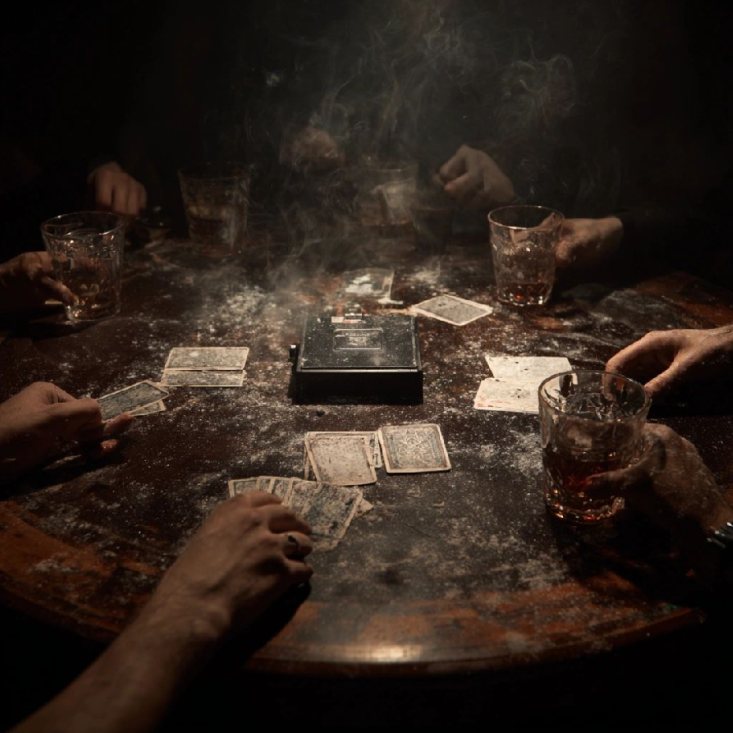
When the lights flicker, and the cards fall, what will you remember?
‘No buy-ins tonight, only what’s left in your head will be accepted.’
Cassie dealt the cards with an assured vigour to the four participants, each one a regular. The room may have been decaying around her, but she maintained herself well. Her black dress still sparkled beneath the flickering light, her raven curls spilling down, nails painted a deliberate purple.
‘We don’t play to win, we play to remember,’ she barked.
Lights flickered around the room, punctuated by gurgling heating radiators. The plaster and lath ceiling was partially exposed, the floor beneath it littered with debris.
Alma the Elder looked at her cards through her one functioning eye, the other lost to a night in the hands of The Commission. She never spoke about what happened; she was just grateful to be alive, sometimes anyway. Her dirty, straggly grey hair fell from beneath the woollen cap she wore. Bony elbows poked out of the holes in her cardigan. Her feet scuffed at the rubble beneath her.
Jay sat opposite her, a man who rarely spoke, in a body that spared its moves. Red hair clung tightly to his almost egg-shaped head; his eyes were darker than a coal miner’s vest.
Li’s empty seat remained just that. It had been for some time. No one spoke of her disappearance, but everyone guessed how it happened. Trying to outsmart The Algorithm was always a dangerous game.
Bruno drew on his cigarette and coughed. An immigrant of the noughties, he arrived on the back of a lorry from Europe. His family never managed to join him as he had hoped. He worked hard until The Commission took charge. Now he was empty and hopeless. His gaunt facial features were skirted with bristles and an ever-present rash. His clothes hung off his frail torso. The only friends he had now were around this very table.
Power was sketchy, the light low, the walls were sweating profusely. Occasional rain seeped down the walls from gaps in boarded windows. A roulette table lay under dust and mildew — hope long broken on its wheel. Here was desperation in its sanctuary, its rotting haven, and twice a week it was home to a makeshift casino.
Money meant nothing, memories were the only currency. The Memory Reader Device sat in the middle of the table. If you knew where to go you could get the Neural element of Version 1.0 of the chip hacked. There was a guy called Ray at the 404 Club. He would do it free of charge; anything to beat The Algorithm.
This allowed one to play, to gamble a memory against those of others. Digital and intangible, first kisses, lost summers, the smell of a Mother’s cooking, the sound of an old friends laugh; this was the only currency allowed in the game. Some were there to win, some didn’t care if they lost, but all were there for the connection in a society that no longer cared or spoke.
A stranger stepped out of the shadows as they prepared to start the first game,
‘Can I join?’
His voice was gruff, his tone businesslike. He moved toward Li’s empty seat.
‘Not there!’ croaked Alma the Elder.
Cassie quickly weighed the tall stranger up. Highly polished black shoes and grey trousers with a smart crease. A black beret sat on his head, his eyes startling blue. There was no smile, no expression. She gave him a chance,
‘We have to move on Alma, let the gentleman sit there please.’
‘It isn’t right,’ she grunted back.
Cassie ignored her, she dealt the stranger a hand,
‘Play clean, respect the pot,’ she instructed, ‘what’s your name by the way, not that anyone cares of course.’
‘Vin,’ he returned.
Everyone stared down at their cards, Alma made the first play, the sound of children playing hit the Memory Reader Device, Bruno smiled briefly, Jay’s expression was unchanged, he upped the ante now, there was a smell of fresh bread, toasted maybe, cheese, coffee. They all seemed to relax for a second.
Cassie sometimes wondered what the point of all this was, there was no real winner. Everyone connected, shared memories, relived happier times. Since The Algorithm took control of the neural grid, every thought was taxed. Every memory had a value. Maybe that was the point of all of this.
The winner would choose what to do with the pot at the end of a game. Memories were either kept (by the greedy) or handed back to the originators. Simple as that really.
Vin upped the ante further, the memory ephemeral, yet more powerful. Everyone experienced a perfect, passionate kiss under a tree in the rain. The sweetness of the memory sparked a brief trickle in their blood flow, a miniscule fluctuation in their collected pulsebeat. That tipped the balance, game to Vin.
They all threw their cards back at Cassie, she shuffled them at speed as she eyed Vin.
He took all the memories in the pot with great haste; he was hungry, or so it seemed. Cassie forgave him in her silence; he was new to the table she reasoned.
He won again, this time with choirs singing Christmas Carols. Cassie redealt the cards. Bruno checked his hand and made his play, the sound of a football crowd, his team scoring, a thousand voices in celebration, strangers hugging strangers on the terrace, the connection. Jay raised now, Spanish guitars, he imagined the sun, a long-lost friend.
Alma pushed her memory into the pot — a child’s laughter echoing through an ancient far-away spring.
Vin didn’t blink. He made his final play with a hollow smile: silence. A memory so deep, so wide, so utterly void that it swallowed all others. One by one, the laughter faded, the kiss vanished, the bread cooled. The Memory Reader Device sparked, whined, then clicked off.
“What did you play?” Cassie asked, breath shallow.
“The last sound before you forget,” Vin said, standing.
“You’re not here to play, are you?” she said, her voice steady.
Vin adjusted his beret,
“I don’t bluff.”
Bruno stared at his empty glass but couldn't remember what had been in it. Jay coughed dryly, eyes flickering, lost. Alma the Elder stood up, fists clenched but trembling.
“You’re harvesting,” Cassie whispered. “You’re here to wipe us.”
Vin nodded once,
“House rules have been changed. The Algorithm no longer accepts sentiment as debt. Only clearance.”
Cassie turned to the table,
“One last round,” she said.
Vin raised an eyebrow.
“Dealer’s memory,” she said, placing both palms on the device. “One for the house.”
The room filled with music — scratchy vinyl — a child singing off-key with a mother in a warm kitchen. The kind of memory too human to price. Tears welled in Alma’s lone eye.
For a moment, Vin paused. Something flickered across his face.
Then he left without a word, the device powered down — empty.
All was gone.